DPP attempts to rewrite colonial history
Editor's note:The Taiwan question is a key focus for China and the international community. China Daily is publishing a series of reports to track hot Taiwan-related topics and address disinformation from the Democratic Progressive Party administration.
SONG CHEN/CHINA DAILY
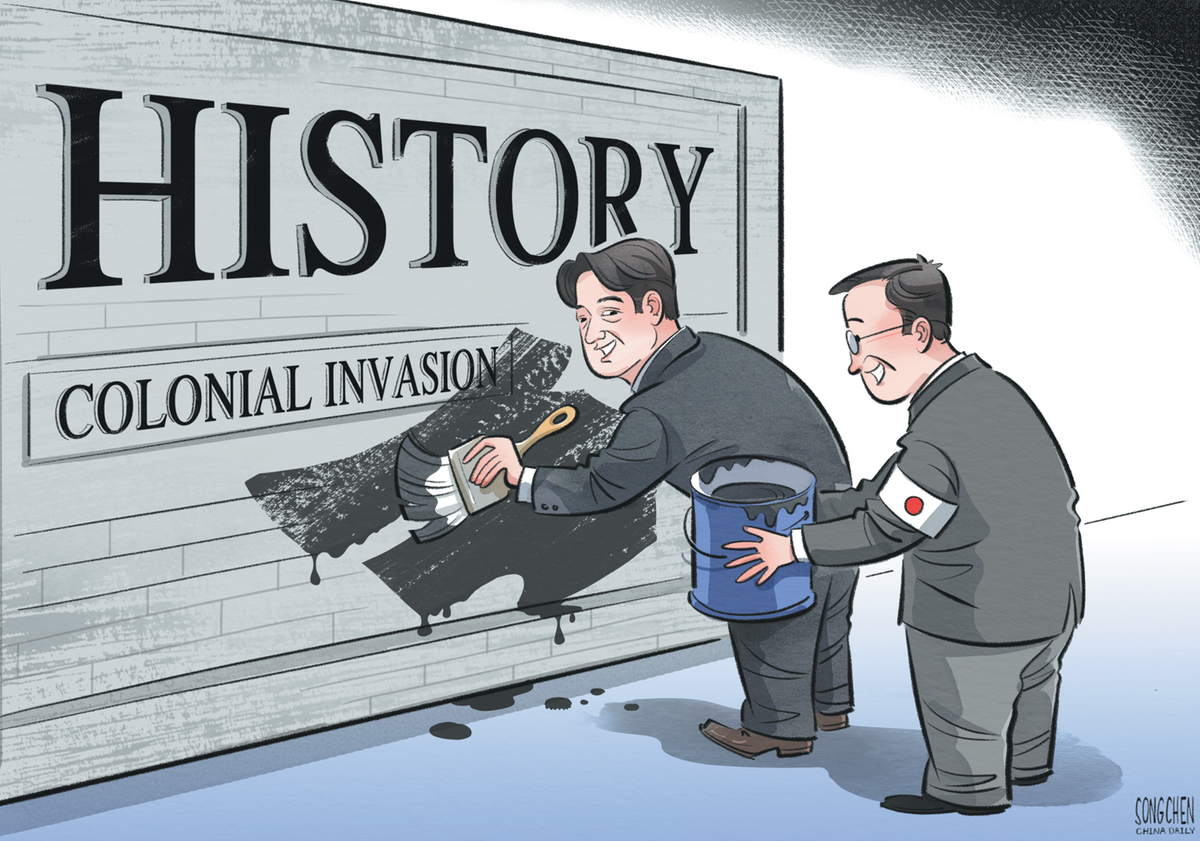
A fragmentary narrative of history under Japanese colonial rule has been used by Taiwan authorities to reshape the historical memory and identity of people on the island in an effort to serve their separatist agenda, analysts said.
As Imperial Japan's first overseas colony, Taiwan endured significant suffering under Japanese colonial rule from 1895 to 1945. Hundreds of thousands of people in Taiwan were killed by the Japanese colonial authorities, while more than 2,000 women on the island were forced into sexual slavery as "comfort women". The 50-year colonial rule ended 81 years ago when Japan was defeated in World War II.
However, the Democratic Progressive Party authorities have sought to erase the history of Japanese aggression in Taiwan while glorifying Japanese colonial rule in an attempt to sever the island's historical and cultural ties with the Chinese mainland, as reflected in their statements about the period and efforts to revise history textbooks.
On Aug 15, the anniversary of Japan's surrender in World War II, the Chinese mainland strongly condemned visits by Japanese officials to the Yasukuni Shrine. The shrine honors Class-A Japanese war criminals from World War II and is regarded as a spiritual symbol of Japanese militarism. In contrast, the DPP authorities in Taiwan said they "respected diverse perspectives on historical events in Japan".
The Lai Ching-te authorities' stance on this historical period has remained ambiguous, with the authorities largely avoiding discussion of Taiwan's resistance against Japanese aggression. This approach has drawn criticism from both Taiwan and the Chinese mainland.
Analysts said Lai's "colonial nostalgia" is intertwined with his pursuit of "Taiwan independence" by relying on Japan. They also warned that reshaping the collective memory of Taiwan society for political purposes could endanger regional peace and stability, particularly amid efforts by Japan's right wing to remilitarize the country.
Resistance against imperial rule
Taiwan was ceded to Japan under the Treaty of Shimonoseki after the Qing Dynasty (1644-1911) was defeated in the First Sino-Japanese War in 1895. From armed resistance and guerrilla warfare to nonviolent movements to defend the island, the people of Taiwan never ceased their resistance to Japanese colonial rule, with more than 600,000 people sacrificing their lives in the struggle.
Wang Xiaoping, a research fellow at the Chinese Academy of Social Sciences' Institute of Modern History, said Taiwan's resistance to Japanese invasion is traced back to the Mudan Incident, when indigenous groups fought against Japanese forces in 1874.
"The anti-Japanese struggles of Taiwan people were part of modern China's resistance to foreign aggression," Wang said. "Unfortunately, this history is neither duly respected nor fully represented in today's Taiwan society."
In March, Lai claimed at a public event that Japan's colonization of Taiwan was aimed at promoting the so-called Greater East Asia Co-Prosperity Sphere. The remark was condemned on both sides of the Taiwan Strait as a "desecration of the martyrs" and a "betrayal of the nation".
In fact, Japan's efforts to develop and build up the island served the empire's goals of colonial economic exploitation and oppression, as well as its subsequent strategy of southward expansion into Southeast Asia, Wang said.
"Agricultural Taiwan, Industrial Japan "was the guiding principle of Japanese colonial policy, under which Taiwan was transformed into a supplier of raw materials and a market for Japanese manufactured goods. The Japanese colonial authorities reaped most of the profits generated on the island, while resources such as rice, sugar, timber and minerals were shipped to Japan, Wang said.
Meanwhile, throughout the Japanese colonial period, the Japanese governor-general maintained autocratic rule through the police apparatus. The people of Taiwan were deprived of the right to vote or stand for election and were subjected to strict and often brutal police control.
Following the outbreak of Japan's full-scale war of aggression against China in 1937, Japanese colonists further launched the "Kominka Movement", an aggressive campaign of Japanese cultural assimilation in Taiwan. Local people were forced to learn Japanese and change their names to Japanese names. Chinese-language newspapers were banned, and traditional Chinese folk practices were abolished.
"It sought to remold Taiwan's people into so-called imperial subjects loyal to the Japanese Emperor, aiming to erode their Chinese national identity," Wang said. "The ultimate goal was to serve Imperial Japan's war efforts."
However, people in Taiwan preserved Chinese culture in various ways, and it remained vibrant on the island, he added.
Although the movement failed, the ideological imprint of Japanization persisted among some individuals even after Taiwan's return to China in 1945. These remnants later contributed to the rise of "Taiwan independence" separatism, negatively affecting relations with the mainland, according to studies on Taiwan's history.
Today, separatist forces on the island have distorted and selectively portrayed history to glorify the modernization achieved under Japanese imperial rule, while deliberately overlooking the suffering and sacrifices of the people of Taiwan, Wang said.
"This incomplete historical narrative diminishes the sacrifice of anti-Japanese resistance martyrs and obscures the significance of Taiwan's return to China," Wang said. He added that it misleads younger generations into believing that "colonization brought modernization", a view directly at odds with global anti-colonial trends.
Erasing history
On Aug 15 last year, marking the 80th anniversary of Japan's surrender in World War II, Lai published an article framed around the concept of the "end of war", thereby evading explicit reference to Japan's surrender or the Chinese victory.
Furthermore, while Taiwan authorities consistently opposed visits by Japanese officials to the Yasukuni Shrine between 2000 and 2015, they have maintained complete silence on the issue for a decade following the DPP's ascension to power in 2016.
Hung Hsiu-chu, former chairwoman of the Chinese Kuomintang, wrote on the same day that "the territorial losses, devastation and humiliation inflicted by colonial imperialism are a history that people on both sides of the Taiwan Strait must never forget".
While attempting to downplay Taiwan's resistance to Japanese colonization, Lai has amplified the "legacy" of Japanese rule. He paid tribute on bended knee to Yoichi Hatta, a Japanese colonial-era engineer, arguing that Taiwan should "remember the source of its water" when considering Japan.
Wang pointed out that the DPP's passive stance on atrocities committed by the Japanese militarists during World War II stems from "Taiwan independence" separatism, which is rooted in the legacy of the Japanese "Kominka Movement" on the island.
"The DPP also curries favor with Japan to advance its separatist agenda, hoping to leverage external forces to contain the mainland," Wang said. "They are reshaping the identity of Taiwan people and altering young people's historical perception to weaken their Chinese identity."
Chi Sing, publisher of The Observer magazine based in Taiwan, said that the authorities under Lai and Tsai Ing-wen have never expressed a clear stance on the issue over the past decade, while repeatedly stressing that "Taiwan and Japan have close relations and jointly maintain regional peace".
This, Chi said, fully reveals their ambition to rely on external forces to seek "independence".
Despite the DPP's attempts to rewrite history, civil groups and individuals in Taiwan have been striving to preserve shared memories of resistance to external aggression. In August, protests were organized on the island to oppose Japan's right-wing military expansion and interference in the Taiwan question.
Because people on both sides of the Taiwan Strait share a common Chinese identity, the DPP's "colonial nostalgia" strains cross-Strait relations by widening the psychological divide, Wang warned. He added that this biased historical narrative risks fracturing Taiwan society, lowering vigilance against Japanese right-wing forces and undermining regional stability.
Recently, the Japanese government has adopted a series of measures to expand its defense forces and weapons. Chi said that Japan's remilitarization would certainly "not be a blessing for the people of Taiwan", as it would jeopardize peace in the Asia-Pacific region and even globally.
KMT's Hung emphasized that history has repeatedly demonstrated that when China is divided, external parties gain, warning that Taiwan should avoid becoming a pawn for foreign forces seeking to exploit the region.